In 2024, Mayor Wu proposed the creation of a $110M Housing Accelerator Fund to speed construction of housing projects in response to the City’s housing shortage. In January 2025, the Boston City Council approved this fund. Approximately $50M of the allocation is set aside to support mixed-income rental housing.
The City’s Accelerator Fund will provide matching co-investment funding alongside MassHousing’s Momentum Fund and BILD Program. The City and State are working collaboratively to place public investment equity that will reduce the cost of capital for new mixed-income housing construction, while advancing local and statewide housing production goals. The City will manage its share of the program in a coordinated effort between the Boston Housing Authority, the City of Boston’s Planning Department, Treasury Department, and the Mayor’s Office of Housing.
This investment approach leverages decades of Boston’s strong financial management to build housing in a way that manages risk to the City.
Purpose
Over the last two years, housing construction nationwide has become enormously expensive due to the high cost of land, labor, materials, and interest rates. The increased costs have slowed housing construction at a time when we urgently need more homes. Boston has been impacted by these challenges as well.
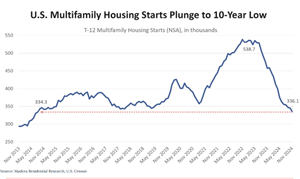 The purpose of the City and State’s investment through this innovative program is to make projects financially feasible and deliver much needed housing for our residents. Based on the amount per unit, the program could help deliver 750-1,000 new homes that are currently stuck and unable to break ground. (Click on image to enlarge)
Frequently Asked Questions:
How does it work?
About 60% of a typical multifamily rental housing project is funded through a loan (senior debt) taken from a financial institution. A developer then needs to find the remaining 40% of funding from other sources — often costly equity investors. The Accelerator Fund reduces the amount of funding needed from private investors, allowing projects that are close to the finish line to become financially feasible, and does so as a City public equity investment earning interest, rather than as an expenditure. MassHousing will pair City and State public equity financing with a permanent mortgage issued through Freddie Mac. 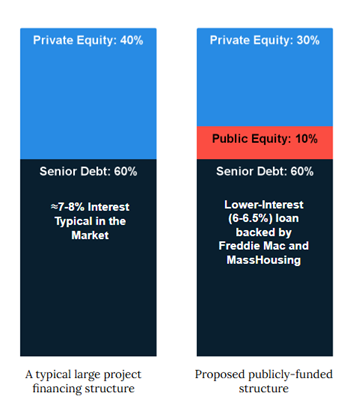
Is City money at risk?
The partnership with MassHousing brings important experience and knowledge that creates confidence in the investment, and allows the City to launch this program without the need to hire and train a whole new set of staff.
-
MassHousing has $5.3 billion in outstanding bonds and loans, and deep expertise with underwriting.
-
MassHousing is also providing projects in the program a Freddie Mac-backed permanent mortgage, which has the added benefit of requiring a second layer of underwriting.
What will projects need to receive equity support?
-
Affordability: Projects must be 20% affordable at 80% of the Area Median Income. This is a requirement of MassHousing’s enabling statute, and aligns with Boston’s Inclusionary Zoning. A small share of units can meet the requirement as voucher set-asides.
-
Market Projects: This is a program for market-oriented mixed-income projects, and is not for projects that receive other forms of public subsidies for housing.
-
Rental: Because of differences in financing structure, this is a rental product only. We are also planning a smaller pilot program for homeownership projects.
-
50+ Units: This fund is designed for projects close to or more than 50 units.
-
Readiness: The project must be BPDA Board approved, and the team must be able to show they are on track to pull a full building permit within 6-12 months, and have their construction financing in place.
-
But-For Need: The project team must be able to show that this financing structure closes the final financial gap for their project to start construction.
-
Impact: We will prioritize projects that show positive community impact and utilize green, sustainable and climate resilient design standards.
How is the Money Allocated?
The $110M allocation funds three component programs:
-
Accelerator/Momentum Fund support for mixed-income rental housing projects,
-
Accelerator support for mixed-income development at the Bunker Hill,
-
A new homeownership pilot (described below).
Accelerator Fund Benefit Boston?
Boston’s housing costs are among the highest in the nation, driven in large part by the City having a severe housing shortage. The City seeks to support the increase in housing supply in order to help alleviate the pressure on housing costs.
How will private market development projects be selected to participate in this program?
After demonstrating their ability to meet the previously listed requirements, we will consider community impact, community support for the project, and climate sustainability development practices.
How many units is this program anticipated to create?
For the rental portion of this program, the City is targeting breaking ground on 750-1,000 new homes in 2026 or early 2027.
Will the City get its money back or is this a grant?
The City anticipates achieving a modest return on its investment.
I’m a Developer and want to understand more about how this works.
View our One-Pager for developers, and feel free to reach out if you have a project that you think might benefit.
How does a developer start the process?
We suggest developers first reach out to the Planning Department to discuss their project. After an initial conversation, Planning staff will coordinate a conversation with MassHousing BILD Program representatives to discuss eligibility and programmatic details..
What is the Homeownership Pilot?
While the Accelerator Fund partnership with the MassHousing BILD/Momentum Fund cannot support homeownership projects, the Boston Housing Authority, in conjunction with the City, is working towards the launch of a smaller pilot version of the program for homeownership projects.